
The capital city on the Istrouma Bluff
Asphalt Paving in Baton Rouge, LA
Driveways, resurfacing, repairs, sealcoat and parking areas for homes, churches and businesses inside the city limits.
- Free on-site estimates
- Itemized written quote with base depth and compacted asphalt thickness
- Driveway pipe, culvert and right-of-way permits sorted out before work is scheduled
Blacktop That Holds Up to Baton Rouge Weather
Asphalt paving in Baton Rouge comes down to two forces: water and heat. The city counted 227,470 people at the 2020 census, and Wikipedia lists average precipitation of 61.94 inches a year, which puts Baton Rouge among the wettest cities in the country. Add a July mean temperature of 83 degrees and you have pavement that spends half the year soaking and the other half baking. We lay new asphalt driveways, overlay worn blacktop, patch potholes and broken edges, sealcoat, and pave and stripe small parking lots across the city.
Why water is the real enemy of blacktop
Asphalt itself sheds rain well. The trouble starts underneath. When water gets through cracks or soaks in along an unsupported edge, the stone base softens, and the next heavy vehicle pushes the surface down into a rut or a pothole. On older Baton Rouge drives we often find a thin layer of asphalt laid straight on dirt or on a few inches of shell, with no crown and no path for water to leave. That pavement fails from the bottom up, no matter how often it is patched on top.
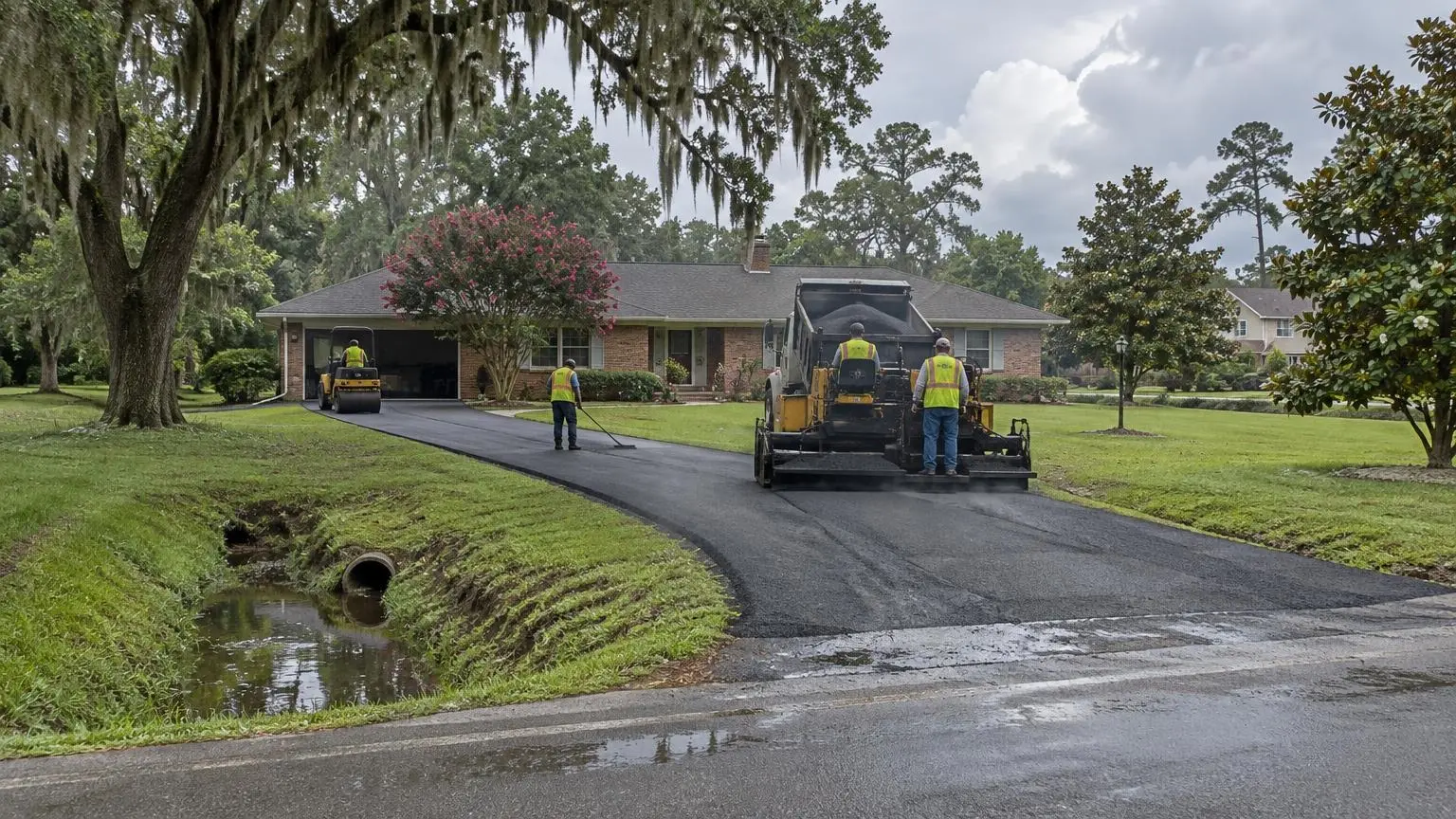
On a new driveway we start with drainage. We grade the subgrade, build a compacted crushed-stone base, and shape the finished surface so water runs to the street, a ditch or a yard drain instead of standing on the blacktop or running back toward the garage.
Heat, scuffing and sealcoat timing
Fresh asphalt stays slightly soft through its first Louisiana summer. Turning the steering wheel while a car is parked can scuff it, and a kickstand or trailer jack can sink a dimple into it on a hot afternoon. That is normal and it fades as the binder cures. Because of that cure time, we usually suggest waiting several months before the first sealcoat on a new drive. After that, a seal every few years slows oxidation from the sun and keeps water out of hairline cracks.
Ditches, culverts and the edge of the street
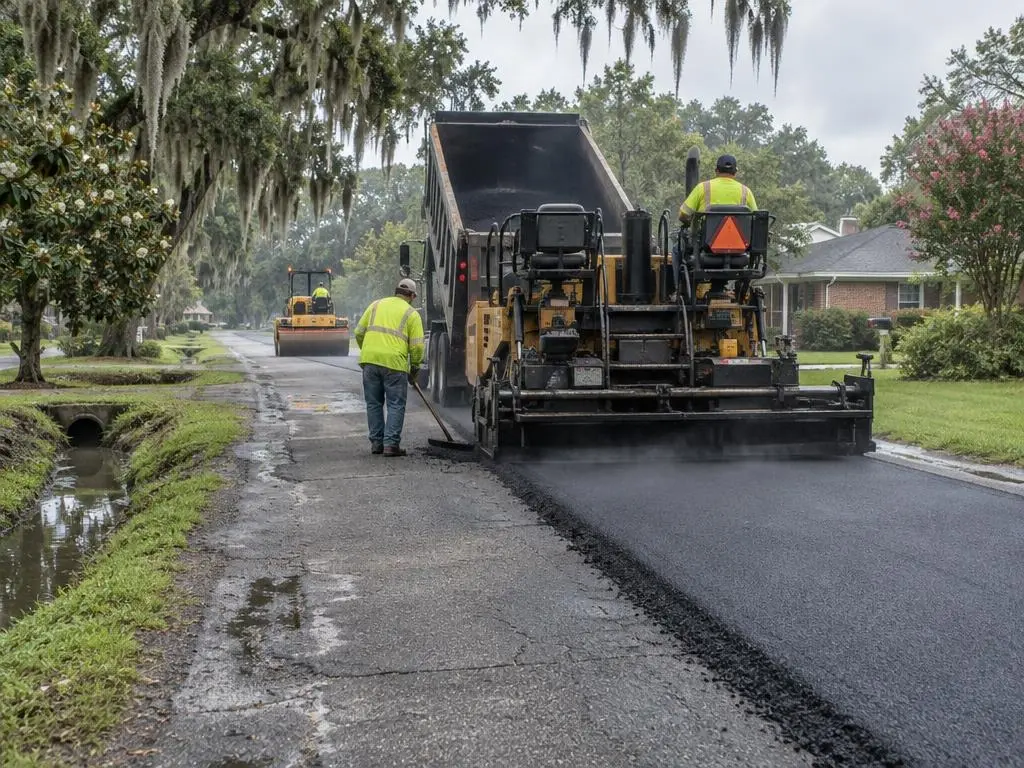
Many Baton Rouge streets still drain to open ditches, so a new or wider driveway often crosses one. The City-Parish Department of Development issues culvert permits. Its form says plastic pipe (PVC or HDPE) may not be used under driveways, driveway pipe must be at least 24 feet long, the trench, bedding and grade are inspected before backfill, and a Louisiana One Call (811) locate is needed before digging. We work that sequence into the schedule, then pave over a pipe that has been set and backfilled properly, with the asphalt edge supported so it does not crumble into the ditch.
Ground that moves under pavement
A Louisiana Geological Survey guide describes two mapped surface faults in the parish, the Baton Rouge fault and the Denham Springs-Scotlandville fault zone, which creep slowly and have damaged roads, pavement and buildings along their traces over decades. If a crack keeps reopening in the same straight line across your lot no matter how often it is filled, it is worth asking whether a fault runs nearby. Most cracking we see, though, comes from clay soil, a thin base and water.
Asphalt work we do in Baton Rouge
- New driveways: tear-out of failed concrete or blacktop, gravel and shell conversions, and wider drives
- Resurfacing: a new layer over sound but worn asphalt, with milling at garage and street edges
- Repairs: potholes, alligator cracking, broken edges and sunken spots dug out and rebuilt
- Sealcoating and crack filling: routine care for driveways and lots
- Parking lots: small lots for churches, offices and shops, plus striping
Call (225) 346-9274 to set up a visit anywhere inside the city.
Baton Rouge Conditions That Shape Asphalt Work
- Rainfall. Wikipedia lists average precipitation of 61.94 inches a year, ranking Baton Rouge among the wettest cities in the United States.
- Summer heat. The climate table gives a July mean of 83 degrees and an annual mean of 68.4 degrees.
- Culvert rules. The City-Parish culvert permit bars PVC or HDPE pipe under driveways and sets a 24-foot minimum pipe length.
- Mapped faults. The Baton Rouge fault and the Denham Springs-Scotlandville fault zone have damaged roads and pavement over decades.
- On the bluff. The city sits on the Istrouma Bluff, the first natural bluff upriver from the Mississippi River delta.
Our Services in Baton Rouge, LA
Baton Rouge Questions
Do I need a permit to pave over a ditch in Baton Rouge?
If the driveway crosses an open ditch, the culvert under it needs a City-Parish permit. The pipe must be at least 24 feet long, plastic pipe is not allowed under driveways, and the trench is inspected before backfill. We plan the culvert and the paving as one job.
Why does my asphalt driveway get soft marks in summer?
New asphalt keeps some flexibility while the binder cures, and Baton Rouge summers are long and hot. Tire scuffs from turning in place and dents from kickstands are common in the first season and fade over time.
How soon can I sealcoat a new asphalt driveway?
We usually suggest waiting several months so the surface can cure first. After that, sealing every few years helps the blacktop resist sun and water.
Can you pave over my old cracked concrete driveway?
Sometimes, if the slabs are stable. If panels are rocking or sunken, it is better to remove them and build a proper stone base, or the cracks will come straight through the new asphalt.
Free Estimates in Baton Rouge, LA
Tell us about your Baton Rouge driveway or lot and we will set up a free written estimate.
Asphalt Paving Near Baton Rouge
- Asphalt Paving in St. George, LA
- Asphalt Paving in Central, LA
- Asphalt Paving in Zachary, LA
- Asphalt Paving in Baker, LA
- Asphalt Paving in Denham Springs, LA
- Asphalt Paving in Walker, LA
- Asphalt Paving in Prairieville, LA
- Asphalt Paving in Gonzales, LA
- Asphalt Paving in Port Allen, LA
- Asphalt Paving in Plaquemine, LA
- Asphalt Paving in Brusly, LA
- Asphalt Paving in Addis, LA
- Asphalt Paving in Merrydale, LA
- Asphalt Paving in Gardere, LA
- Asphalt Paving in St. Gabriel, LA
- Asphalt Paving in Livingston, LA
- Asphalt Paving in Watson, LA
- Asphalt Paving in Sorrento, LA
- Asphalt Paving in Slaughter, LA
- Asphalt Paving in Pride, LA
- Asphalt Paving in French Settlement, LA
- Asphalt Paving in Brownfields, LA